Why ChatGPT Doesn't Recommend Your Business & How to Fix It
2026-08-18
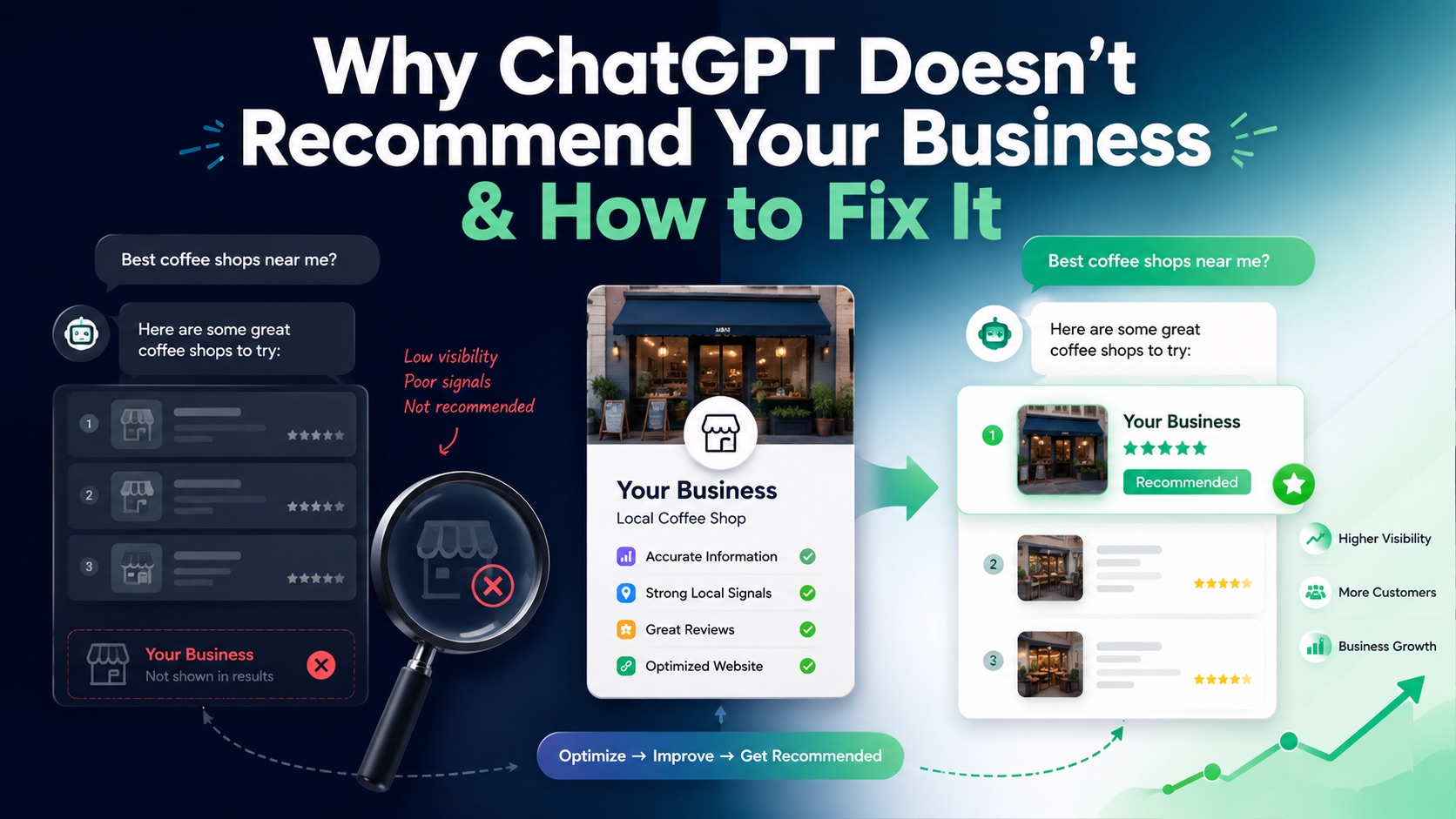
Why Your Business Doesn't Come Up When Someone Asks ChatGPT for a Recommendation
Say a homeowner in Brick needs a roofer. A few years ago she opened Google and scrolled through the results. Last month she typed the question into ChatGPT and got three company names back, each with a sentence explaining why. Yours was not one of them. You rank on page one for "roofer Brick NJ," you have 60 reviews, and you still lost the job before she ever visited a website.
People Are Asking Chatbots the Questions They Used to Google
A growing share of "who should I hire" searches now happen inside ChatGPT, Gemini, Perplexity, and Copilot instead of a search results page. The question sounds the same. The output does not.
Google gives your customer ten organic listings, a map pack, and some ads. That is roughly a dozen chances to get noticed. An AI assistant usually names three to five businesses and moves on. There is no page two and no chance you’ll get lucky and the customer will scroll past the ads to find you.
That shrinks the shortlist by a lot. If you were the seventh result on Google, you were still findable. Seventh place in an AI answer does not exist.
Where AI Assistants Actually Get Their Answers
These tools assemble answers from a mix of sources: your website copy, your Google Business Profile, directory listings, review platforms, local news coverage, and discussion sites like Reddit. Some of them run a live web search first and summarize what comes back. Others lean on what they already have stored.
What they share is a preference for information stated plainly and repeated consistently across places. A model looking for a roofer in Ocean County wants to confirm three things fast: what you do, where you do it, and whether anyone else says you are good at it.
Now picture a five-page website built in 2018, a Facebook page updated twice a year, and a Google profile with the old phone number on it. There is almost nothing there for the model to assemble. So it’s not that the model decides your business is bad, but verifiable information about the business isn’t there, so it names another business that it can describe with confidence.
Why You Get Skipped Even When You Rank Fine on Google
Ranking and citation are two different games. Google ranks pages that match a query. An AI assistant extracts facts and needs to feel certain about them before repeating them to a user.
Most small business sites make that hard without meaning to. Service pages run three sentences and a photo gallery. The towns you serve live inside a rotating image slider that has no readable text. Your pricing is never mentioned anywhere. Your business name shows up as "Smith Roofing" on the site, "Smith Roofing LLC" on Google, and "Smith Roofing & Siding" on Yelp. Every one of those gaps is a reason for a model to hedge and pick the competitor whose site answers the question outright.
The competitor getting named is often the one with the plainer website. Clean headings, real sentences, a service area list written in actual text. That site is easier to read, and, in this landscape, being easy to read give site’s a huge advantage.
What You Can Check on Your Own Site Today
Spend twenty minutes on this before you spend a dollar with anyone.
- Open ChatGPT and ask the five questions your customers would ask, using your town and your service, then write down which businesses get named and how they get described.
- Search your business name across Google, Yelp, Facebook, and any industry directory you belong to, and confirm the name, address, and phone match character for character.
- Pull up your main service page and count how many sentences describe what the service includes, what it costs, and who it is for. Under 300 words of real copy is thin.
- Find where your service area is listed and check whether the town names appear in readable text rather than inside an image, a slider, or a PDF.
- Read your homepage as if you know nothing about your company and see whether it says what you do and where in the first two sentences.
That list will tell you more about your visibility problem than most paid audits will.
The AI Search Advice That Won't Help You
Two pitches are making the rounds right now, and both waste money.
The first is the schema plugin fix. Someone installs structured data across your site, sends a report, and calls it done. Schema helps a machine label information that already exists. Adding it to a page with nothing on it labels the emptiness.
The second is worse: agencies selling packages of 40 AI-written blog posts as an "AI visibility" strategy. Generic content assembled by a model is exactly what other models learn to skip. Publishing volume without substance gives you a bigger site that says nothing new, and it can bury the few pages you actually have that are worth citing.
There is a flip side worth saying too. Some designers will tell you this is all hype and there is nothing to be done. That is also wrong. The businesses getting named in AI answers usually have deep service pages, consistent listings, real third-party mentions, and content that answers specific questions. None of that is mysterious. Most of it is the same work that made sites rank well before any of this existed, done properly instead of half done.
Want to Know Why AI Tools Recommend Your Competitors Instead of You?
If you ran the questions above and watched other companies in your market get named while yours went unmentioned, the problem is usually structural, and it rarely gets fixed by adding another blog post. ShoreSite Web Designs can audit your site, your listings, and your content to find out exactly what these tools can and cannot say about your business. We will tell you what is worth fixing first and what can wait. Call us at (732) 800-1766 or reach out at https://shoresitedesigns.com/contact/ and we will take a look.